LangChain vs AcruxCore SDK: the same tool-calling agent
In the previous post we wrote the same tool-calling agent against a raw OpenAI-compatible client on both platforms and hand-rolled the loop. AcruxCore needed 105 lines to LangSmith's 63 — we lost that one, and said so.
This post is the other half: what happens when you use each platform's own abstraction
instead of writing the loop yourself. LangChain's create_agent against the AcruxCore
SDK's run_tool_loop. Same tool, same question, same model (openai/gpt-4o-mini via
OpenRouter), both run live.
LangChain: the tool is a decorated function, the loop is a graph
LangChain derives the tool schema from your type hints and docstring, which is a genuinely nice trick — you write one function and the JSON Schema falls out of it:
@tool
def get_weather_tool(city: str) -> dict:
    """Get the current weather for a city.

    Returns temperature in Celsius, what it feels like, a text condition, and humidity.

    Args:
        city: City name, e.g. 'Lahore' or 'Berlin'.
    """
    return get_weather(city)


model = ChatOpenAI(model="openai/gpt-4o-mini", api_key=..., base_url="https://openrouter.ai/api/v1")
agent = create_agent(model=model, tools=[get_weather_tool], system_prompt=SYSTEM_PROMPT)
result = agent.invoke({"messages": [{"role": "user", "content": QUESTION}]})
Tracing needs zero lines. Set LANGCHAIN_TRACING_V2=true before the import and every
run reports itself. That is the strongest thing about the LangChain/LangSmith pairing: if
you are already on LangChain, observability costs you an environment variable.
What you get in the trace is a graph, not a list:
LangGraph                     386 tokens
├─ model
│   └─ ChatOpenAI             150
├─ tools
│   └─ get_weather_tool
└─ model
    └─ ChatOpenAI             236
Seven runs for one agent turn. The model and tools wrappers are LangGraph's own nodes.
Useful when you are debugging the graph itself; noise when you only want to know what the
tool returned.
AcruxCore: the same decorator, and the tool becomes a catalog version
The AcruxCore side is the LangChain shape with one word changed:
from acruxcore import AcruxCore, acrux

@acrux.tool
def get_weather_local(city: str) -> dict:
    """Get the current weather for a city.

    Returns temperature in Celsius, what it feels like, a text condition, and humidity.

    Args:
        city: City name, e.g. 'Lahore' or 'Berlin'.
    """
    return get_weather(city)


async with AcruxCore() as client:
    result = await client.run_tool_loop(
        model="gpt-4o-mini",
        messages=build_messages(),
        tools=[get_weather_local],
        trace={"name": "weather-tool-agent-sdk"},
    )
@acrux.tool reads the same three things off the function that LangChain's @tool does:
the name from __name__, the model-facing description from the docstring summary,
and the argument schema from the type hints, with each Args: line becoming that
property's description. run_tool_loop owns the whole loop — call the model, run the tool
calls, append results, repeat — and reports one trace over all of it.
The difference is what happens to the tool. On the first call the loop sends the derived
spec to POST /tools/sync, and the tool becomes a versioned catalog entry: name,
description, parametersSchema, version number, production and staging aliases. That
call is create-or-commit-or-nothing — it creates the tool when the name is new, commits a
version only when the spec changed, and commits nothing on a re-run — so it is safe at the
top of a long-running service. We verified the idempotency: run the script twice and the
version count stays at 1.
So the tool exists in two places at once, deliberately. The catalog owns the contract that the model is shown, and your function owns the body. Any other service, in any language, can resolve that contract and call the tool; and you can promote a new version from the dashboard without touching this file.
Two ways in, and why this post uses one of them
There are exactly two ways a tool gets into the catalog, and the choice follows from one question: who runs the tool body?
| The body is | You declare it with | Who executes it |
|---|---|---|
| a function in your code | @acrux.tool on the function | your process |
| an HTTP request to some API | an http executor via POST /tools/sync, or the dashboard | the platform |
Both produce the same artifact — a versioned catalog entry with aliases — and neither needs
a setup step before your script runs. The version records which one it is in its executor
field, so nothing has to guess later:
{"type": "client"}                                   // your app runs it
{"type": "http", "url": "...", "method": "GET", ...} // the platform runs it
This post uses the first. The previous post
uses the second, which is why the tool here is named get_weather_local rather than reusing
that post's get_weather: one name per execution model, so neither version lies about who
does the work.
Build and attach a tool walks through the whole path — declaring, syncing, inspecting the result in the dashboard, attaching it to a prompt, and the routing rules for tools you did not declare locally.
The trace
From the self-contained run at the end of this post, which declares the same tool under the
name get_weather_standalone:
weather-agent-standalone      3 spans   371 tokens   ok
├─ llm  (openai/gpt-4o-mini)  1632ms   131
│   └─ tool get_weather_standalone   603ms   (toolVersionId 82e53d6a…:1)
└─ llm  (openai/gpt-4o-mini)  1746ms   240
Three spans, one per thing that actually happened. The client-side tracing code for this is
none: no tracing SDK, no decorator, no span object. The gateway writes the llm spans
because it is the thing making the provider call, and the SDK writes the tool span around
your function and threads it into the same trace.
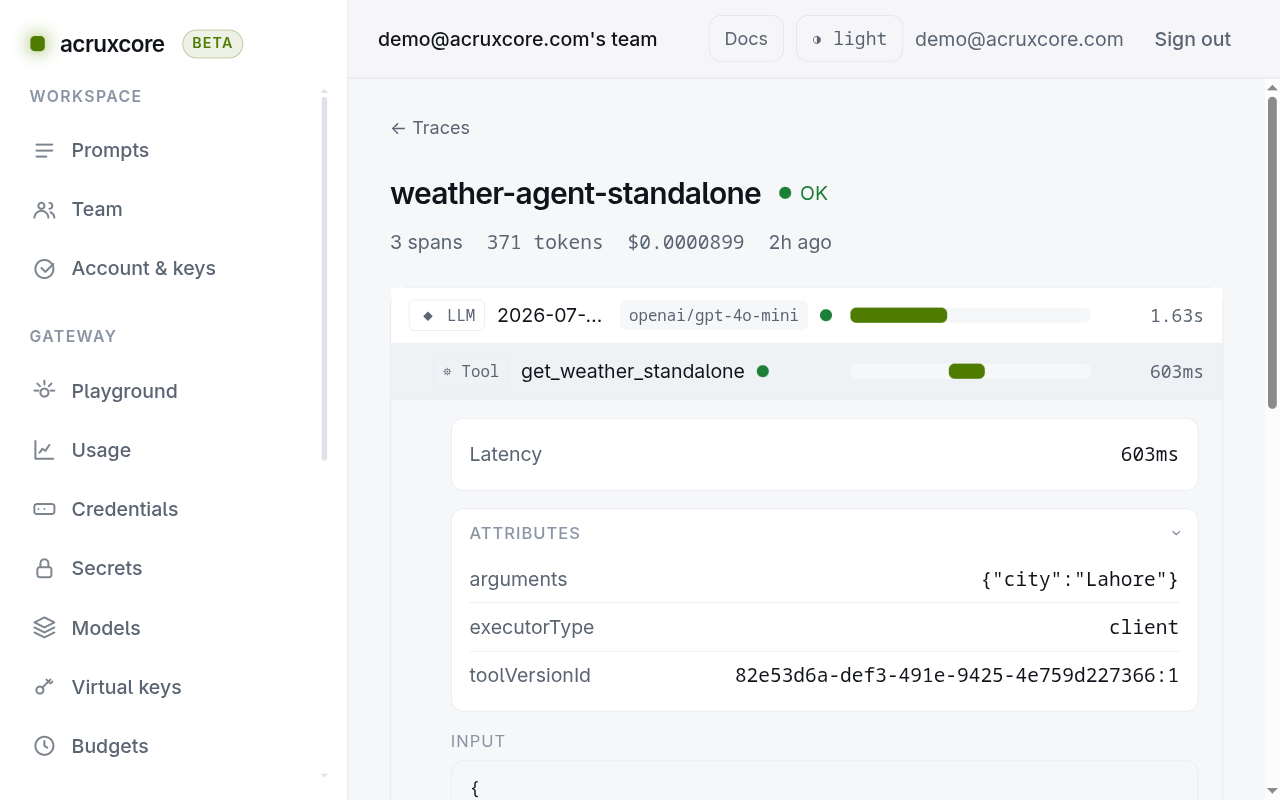
executorType: client is the span saying your process ran the tool, and toolVersionId
names the exact contract version the model was shown — the thing a decorated local function
on its own cannot tell you, and the reason the catalog round-trip is there at all.
Counting the code
One rule for this to mean anything: each script must run on its own, with no setup done beforehand in a terminal or a dashboard. Registration counts if it is required. Lines of real code, excluding docstrings, comments and blank lines:
| LangChain + LangSmith | AcruxCore SDK | |
|---|---|---|
| Agent with tracing | 50 | 36 |
| Complete self-contained script (the two at the end of this post) | 40 | 40 |
The first row differs because the LangChain leg wires the model client itself —
ChatOpenAI(model=..., api_key=..., base_url=...) plus the tracing env vars — while the
AcruxCore leg names a model the gateway already knows. On the fully self-contained scripts
the two are level at 40 lines each.
Both figures are checkable: the two self-contained scripts are at the end of this post, and the pair behind the first row is here. They import one shared module for the tool body and the question, which is printed in full in the previous post.
tool_agent_langchain.py — LangChain's create_agent, 50 lines of code
"""SDK leg: the same get_weather agent using LangChain + LangSmith.

The counterpart to `tool_agent_acruxcore_sdk.py`. LangChain's `create_agent`
owns the loop, `@tool` turns a plain function into a tool with a schema derived
from its type hints and docstring, and tracing needs no code at all — importing
LangChain with `LANGCHAIN_TRACING_V2=true` set is enough.

Run:
  export LANGSMITH_API_KEY=lsv2_pt_...
  export OPENROUTER_API_KEY=sk-or-v1-...
  python scripts/blogs/tool-agent-sdk-langchain-vs-acruxcore/python/tool_agent_langchain.py

Needs: pip install langchain langchain-openai langsmith
"""

import json
import os
import sys

PROJECT = "weather-tool-agent-langchain"

# Must be set before LangChain is imported — the tracer reads them at import time.
os.environ["LANGCHAIN_TRACING_V2"] = "true"
os.environ["LANGCHAIN_PROJECT"] = PROJECT
os.environ["LANGSMITH_PROJECT"] = PROJECT

if not os.environ.get("LANGSMITH_API_KEY"):
    sys.exit("LANGSMITH_API_KEY is not set")
if not os.environ.get("OPENROUTER_API_KEY"):
    sys.exit("OPENROUTER_API_KEY is not set")

from langchain.agents import create_agent  # noqa: E402  (after the env vars above)
from langchain_core.tools import tool  # noqa: E402
from langchain_openai import ChatOpenAI  # noqa: E402

from weather_tool_shared import (  # noqa: E402
    MODEL_OPENROUTER,
    QUESTION,
    SYSTEM_PROMPT,
    get_weather,
)


@tool
def get_weather_tool(city: str) -> dict:
    """Get the current weather for a city.

    Returns temperature in Celsius, what it feels like, a text condition, and humidity.

    Args:
        city: City name, e.g. 'Lahore' or 'Berlin'.
    """
    return get_weather(city)


def main() -> None:
    """Build the agent and run the same question through it."""
    model = ChatOpenAI(
        model=MODEL_OPENROUTER,
        api_key=os.environ["OPENROUTER_API_KEY"],
        base_url="https://openrouter.ai/api/v1",
    )
    agent = create_agent(model=model, tools=[get_weather_tool], system_prompt=SYSTEM_PROMPT)

    result = agent.invoke({"messages": [{"role": "user", "content": QUESTION}]})

    messages = result["messages"]
    tool_calls = [
        {"name": tc["name"], "args": tc["args"]}
        for m in messages
        for tc in (getattr(m, "tool_calls", None) or [])
    ]
    print(
        json.dumps(
            {
                "answer": messages[-1].content,
                "tool_calls": tool_calls,
                "message_count": len(messages),
            },
            indent=2,
        )
    )
    print(f"\nLangSmith project: {PROJECT}")


if __name__ == "__main__":
    main()
tool_agent_acruxcore_sdk.py — the AcruxCore SDK's run_tool_loop, 36 lines of code
"""SDK leg: the same get_weather agent using the `acruxcore` Python SDK.

This is the third way to write the run, after the raw-REST/OpenAI-client legs.
`run_tool_loop` owns the entire loop — call the model, run the tool calls, append
results, repeat — and reports one trace covering all of it. Three things disappear
compared to `tool_agent_acruxcore.py`:

* No registration step: `@acrux.tool` is the tool definition, and the loop
  reconciles it with the catalog on its first call. Re-running with an unchanged
  function commits nothing.
* No tool schema is assembled: the derived schema is what the catalog holds, and
  the gateway serves the model that same version.
* No trace plumbing: no trace id to mint, no headers to set, no parent span to
  thread. The gateway writes the `llm` spans, the SDK writes the `tool` spans.

Run:
  export ACRUXCORE_API_KEY=acx_sk_...
  python scripts/blogs/tool-agent-sdk-langchain-vs-acruxcore/python/tool_agent_acruxcore_sdk.py

Needs: pip install acruxcore
"""

import asyncio
import json
import os
import sys
from typing import Any

from acruxcore import AcruxCore, acrux

from weather_tool_shared import MODEL_ACRUXCORE, build_messages, get_weather

BASE_URL = os.environ.get("ACRUXCORE_BASE_URL", "https://acruxcore.com/api/v1")
TRACE_NAME = "weather-tool-agent-sdk"

if not os.environ.get("ACRUXCORE_API_KEY"):
    sys.exit("ACRUXCORE_API_KEY is not set")


# A distinct name from the `http`-executor `get_weather`: this loop runs the tool in
# this process, so its version declares a `client` executor. Registering both under
# one name would mean one of them lying about who runs the tool. The decorator takes
# the name from the function, so the distinction lives in the function name.
@acrux.tool
def get_weather_local(city: str) -> dict[str, Any]:
    """Get the current weather for a city.

    Returns temperature in Celsius, what it feels like, a text condition, and humidity.

    Args:
        city: City name, e.g. 'Lahore' or 'Berlin'.
    """
    return get_weather(city)


async def main() -> None:
    async with AcruxCore(api_key=os.environ["ACRUXCORE_API_KEY"], base_url=BASE_URL) as client:
        result = await client.run_tool_loop(
            model=MODEL_ACRUXCORE,
            messages=build_messages(),
            # One argument replaces the register-then-reference dance: the loop syncs
            # this tool, then names it to the gateway as a catalog ref.
            tools=[get_weather_local],
            trace={"name": TRACE_NAME},
        )

    print(
        json.dumps(
            {
                "answer": result.content,
                "iterations": result.iterations,
                "stopped_at_limit": result.stopped_at_limit,
                "trace_id": result.trace_id,
            },
            indent=2,
        )
    )
    print(f"\nAcruxCore trace: {BASE_URL.replace('/api/v1', '')}/traces/{result.trace_id}")


if __name__ == "__main__":
    asyncio.run(main())
An earlier version of this post showed AcruxCore winning by a wider margin, because the
count left out getting the tool into the catalog — we had done that beforehand with curl, so
the comparison charged LangChain for its @tool and charged us for nothing. If a benchmark
shows a platform's own product winning, check what happened before the script ran.
What you buy for those 40 lines still differs. LangChain gives you a graph and a large ecosystem of components. AcruxCore gives you a versioned catalog artifact your other services can call, in any language, and a version you can promote without redeploying the caller.
Where each one is actually better
On tool ergonomics they are now level. Both decorators read the schema off your type hints and docstring, and neither needs a separate registration step.
AcruxCore wins on the loop and the trace. One call replaces the loop, parallel tool
calls are dispatched concurrently for you, and the trace has one span per real event
instead of a graph node per framework abstraction. Schema drift is also off the table: the
model is handed whatever production points at, so the definition cannot fall out of step
with the code the way a hand-maintained schema can.
LangChain wins on reach. If your agent needs retrievers, memory, a vector store and four integrations, that ecosystem exists and ours does not.
On tracing setup they are effectively tied at zero. LangChain needs an env var; the AcruxCore SDK needs nothing, because the trace is a property of the gateway call rather than something a client library has to be told to emit.
Already committed to LangChain? Stay there and turn on LangSmith — the marginal cost of
observability is one environment variable. Building services in more than one language, or
wanting to change a tool without redeploying its callers? The catalog plus run_tool_loop
buys you a versioned artifact and a cleaner trace, for the same amount of code.
Run it yourself: the two complete scripts
Everything above is excerpts. These two are the whole thing — no local imports, nothing to set up in a dashboard or a terminal first. Both were executed exactly as printed, and the output of those runs is shown underneath each one. Open either to copy it.
standalone_langchain_agent.py — LangChain + LangSmith, 40 lines
pip install langchain langchain-openai langsmith requests
export LANGSMITH_API_KEY=lsv2_pt_...
export OPENROUTER_API_KEY=sk-or-v1-...
python standalone_langchain_agent.py
"""Complete, self-contained LangChain + LangSmith tool agent.

Copy-pasteable: no local imports, nothing to set up first. This is the version
embedded in the blog post, kept here so it can be run and stay honest.

  pip install langchain langchain-openai langsmith requests
  export LANGSMITH_API_KEY=lsv2_pt_...
  export OPENROUTER_API_KEY=sk-or-v1-...
  python standalone_langchain_agent.py
"""

import os

# Must be set before LangChain is imported — the tracer reads them at import time.
os.environ["LANGCHAIN_TRACING_V2"] = "true"
os.environ["LANGCHAIN_PROJECT"] = "weather-agent-standalone"

import requests
from langchain.agents import create_agent
from langchain_core.tools import tool
from langchain_openai import ChatOpenAI

MODEL = "openai/gpt-4o-mini"
SYSTEM_PROMPT = (
    "You are a concise outdoor-activity advisor. When a question depends on the "
    "weather, call the weather tool before answering. Answer in at most three "
    "sentences and always state the temperature you based the advice on."
)


@tool
def get_weather(city: str) -> dict:
    """Get the current weather for a city.

    Returns temperature in Celsius, what it feels like, a text condition, and humidity.

    Args:
        city: City name, e.g. 'Lahore' or 'Berlin'.
    """
    res = requests.get(f"https://wttr.in/{city}", params={"format": "j1"}, timeout=20)
    res.raise_for_status()
    payload = res.json()
    current = payload["current_condition"][0]
    return {
        "location": payload["nearest_area"][0]["areaName"][0]["value"],
        "temp_c": int(current["temp_C"]),
        "feels_like_c": int(current["FeelsLikeC"]),
        "condition": current["weatherDesc"][0]["value"],
        "humidity_pct": int(current["humidity"]),
    }


def main() -> None:
    model = ChatOpenAI(
        model=MODEL,
        api_key=os.environ["OPENROUTER_API_KEY"],
        base_url="https://openrouter.ai/api/v1",
    )
    agent = create_agent(model=model, tools=[get_weather], system_prompt=SYSTEM_PROMPT)

    result = agent.invoke(
        {"messages": [{"role": "user", "content": "Should I go for a run in Lahore this evening?"}]}
    )

    print(result["messages"][-1].content)
    print(f"\nTrace: smith.langchain.com → project '{os.environ['LANGCHAIN_PROJECT']}'")


if __name__ == "__main__":
    main()
Real output:
The temperature in Lahore is currently 40°C, which feels like 35°C. It's quite hot, so
consider an evening run only if you are well-hydrated and accustomed to high temperatures.
Otherwise, it may be better to postpone your run for a cooler time.

Trace: smith.langchain.com → project 'weather-agent-standalone'
standalone_acruxcore_sdk_agent.py — AcruxCore SDK, 40 lines
pip install acruxcore requests
export ACRUXCORE_API_KEY=acx_sk_...
python standalone_acruxcore_sdk_agent.py
"""Complete, self-contained AcruxCore SDK tool agent.

Copy-pasteable: no local imports, nothing to set up first. `@acrux.tool` carries the
name, the model-facing description and the argument schema, and `run_tool_loop`
reconciles that with the Tool Catalog on its first call. This is the version embedded
in the blog post, kept here so it can be run and stay honest.

  pip install acruxcore requests
  export ACRUXCORE_API_KEY=acx_sk_...
  python standalone_acruxcore_sdk_agent.py
"""

import asyncio
import os

import requests
from acruxcore import AcruxCore, acrux

BASE_URL = os.environ.get("ACRUXCORE_BASE_URL", "https://acruxcore.com/api/v1")
API_KEY = os.environ["ACRUXCORE_API_KEY"]
MODEL = "gpt-4o-mini"

SYSTEM_PROMPT = (
    "You are a concise outdoor-activity advisor. When a question depends on the "
    "weather, call the weather tool before answering. Answer in at most three "
    "sentences and always state the temperature you based the advice on."
)


@acrux.tool
def get_weather_standalone(city: str) -> dict:
    """Get the current weather for a city.

    Returns temperature in Celsius, what it feels like, a text condition, and humidity.

    Args:
        city: City name, e.g. 'Lahore'.
    """
    res = requests.get(f"https://wttr.in/{city}", params={"format": "j1"}, timeout=20)
    res.raise_for_status()
    payload = res.json()
    current = payload["current_condition"][0]
    return {
        "location": payload["nearest_area"][0]["areaName"][0]["value"],
        "temp_c": int(current["temp_C"]),
        "feels_like_c": int(current["FeelsLikeC"]),
        "condition": current["weatherDesc"][0]["value"],
        "humidity_pct": int(current["humidity"]),
    }


async def main() -> None:
    async with AcruxCore(api_key=API_KEY, base_url=BASE_URL) as client:
        result = await client.run_tool_loop(
            model=MODEL,
            messages=[
                {"role": "system", "content": SYSTEM_PROMPT},
                {"role": "user", "content": "Should I go for a run in Lahore this evening?"},
            ],
            # The first call creates the tool, commits v1 and points `production` at it.
            # A later run with an unchanged function commits nothing.
            tools=[get_weather_standalone],
            trace={"name": "weather-agent-standalone"},
        )

    print(result.content)
    print(f"\nTrace: {BASE_URL.replace('/api/v1', '')}/traces/{result.trace_id}")


if __name__ == "__main__":
    asyncio.run(main())
Real output — this is the run whose trace is shown earlier in the post:
The current temperature in Lahore is 34°C, but it feels like 38°C with smoky haze. It's
advisable to avoid running in these conditions, as the heat and air quality may affect your
health. Consider postponing your run until temperatures are cooler and the air quality
improves.

Trace: https://acruxcore.com/traces/d29ff672-a065-4e7a-877f-104d4dce5685
The difference in what you had to write is the whole comparison in one place. LangChain: a decorated function and three lines of wiring. AcruxCore: a decorated function and three lines of wiring — plus a versioned catalog artifact your other services can call and a version you can promote without touching this code.