Retries and fallbacks: what the gateway does when a provider call fails
What you'll build: a model with a fallback chain, a call that sets its own retry count, a call that is not allowed to fall back, and two traces you can read side by side to tell a retry from a fallback.
A retry and a fallback are not the same thing. A retry calls the same model on the same credential again, because the failure looked temporary. A fallback gives up on that model and calls a different registered model instead. The gateway does both, in that order. The two are configured in completely different places, and mixing them up is the common mistake.
Three layers, three places to set them
There is a third retry above both of these: the SDK retrying its own HTTP request to AcruxCore. All three are called retries, and each one is a different setting.
| What it re-sends | Where you set it | Default |
|---|---|---|
| The SDK's own request to AcruxCore | The client constructor: new AcruxCore({ maxRetries }) in Node, AcruxCore(max_retries=...) in Python | 1 extra attempt, 500ms apart |
| The same model on the same credential | The request body: gateway.maxRetries, 0 to 5 | 1 extra attempt, backing off |
| A different registered model | The model's fallback chain | No fallbacks |
The order inside one gateway call is fixed. The gateway tries the first model and
retries it up to gateway.maxRetries times on a transient error. Only then does it
move to the next model in the fallback chain, where the same retry budget starts
again.
A 30-second budget runs alongside this, and it governs retries only. Once 30 seconds have passed, no model is tried a second time, but the chain still walks the models it has not reached yet, one attempt each. So the budget caps how long the gateway spends repeating itself, not how long the whole chain can take.
The SDK's own retry sits above all of that. It fires when the SDK cannot reach AcruxCore at all, and it re-sends the whole request, which starts the gateway's retry and fallback sequence over from the beginning.
1. Give a model a fallback chain
A fallback is a property of the model, not of the call. Every caller of that
model inherits the chain, and no caller can ask for a different one. A request
sends "model": "free-tier-model" and nothing else. Which models stand behind that
name is decided once, in the registry, for everyone. The one thing a caller can do
per request is switch the chain off, which is step 3.
Open Gateway → Models and click New model. The dialog asks for the public name callers will send, the credential to call it on, and the upstream model name that credential's provider knows. The Fallbacks list holds every other registered model as a checkbox, and each box you check is numbered with its position in the chain:
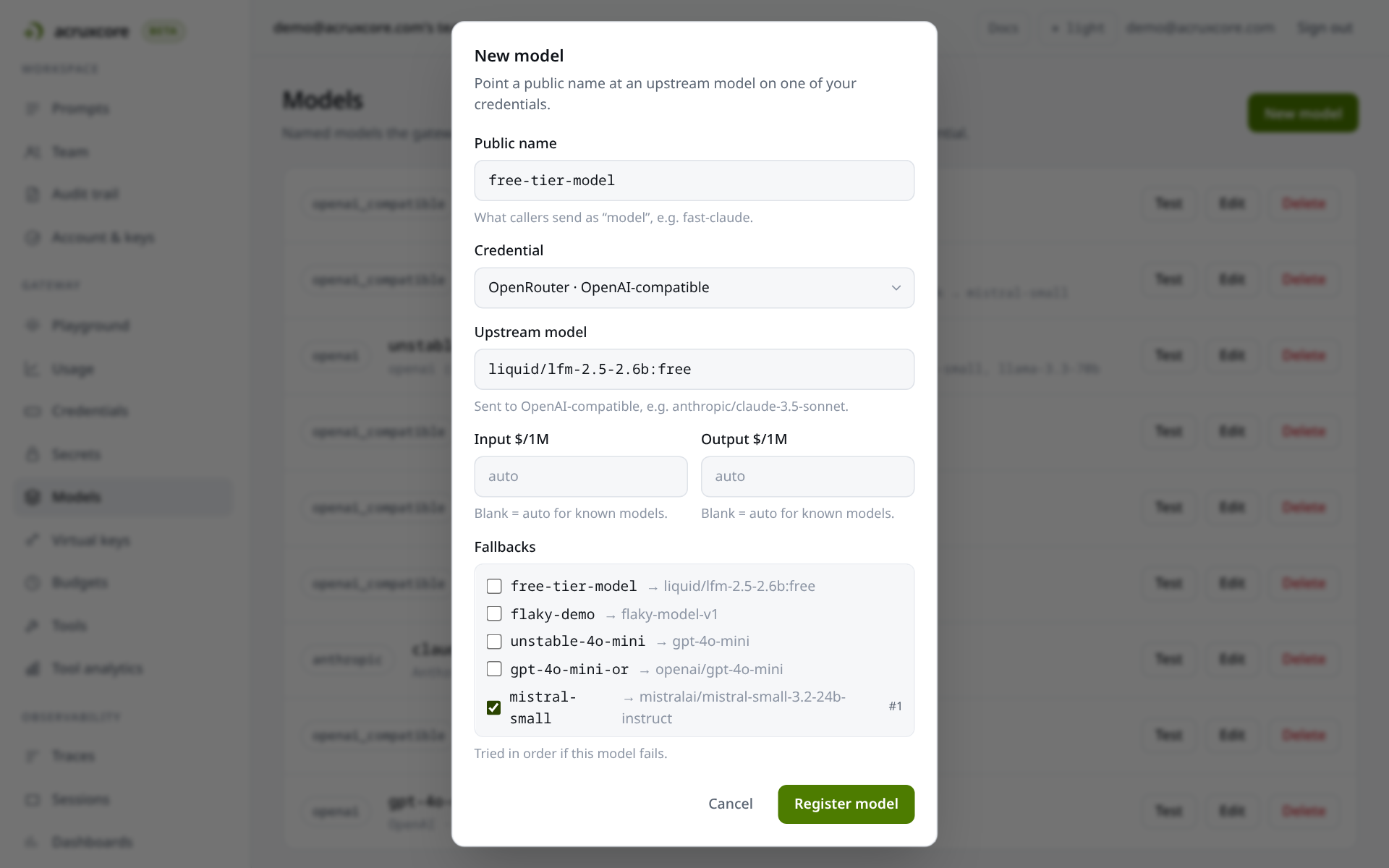
free-tier-model points at a free upstream model, which rate-limits under load.
That is why this guide uses it: a free tier fails the way a busy provider fails, on
demand, so the retry you will read in step 4 is a real one.
Save, and the summary line under each model spells out its whole chain in order. You can read every fallback without opening anything:
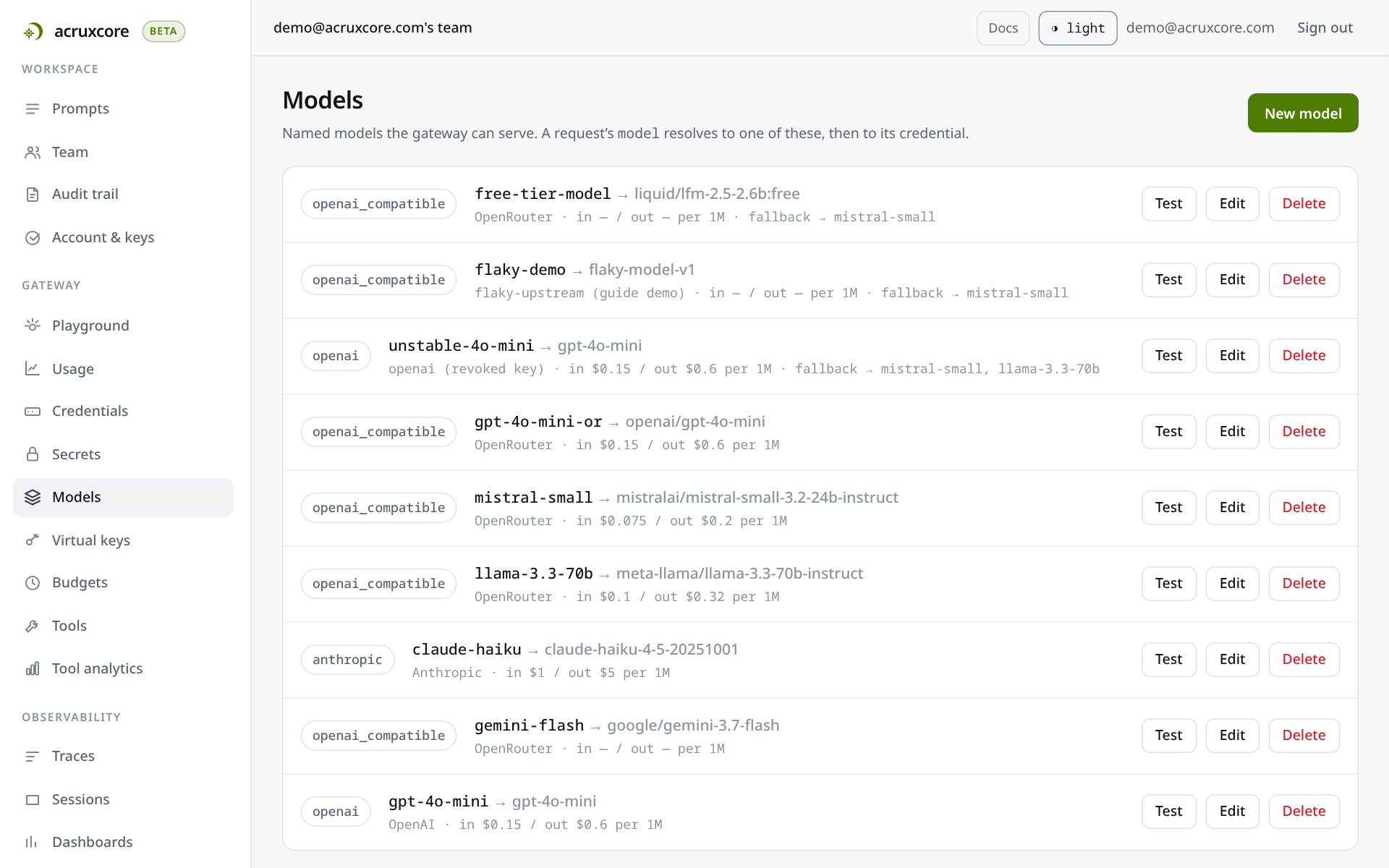
Click Edit on a model to change a chain that already exists. The same Fallbacks list appears, with the current chain checked and numbered:
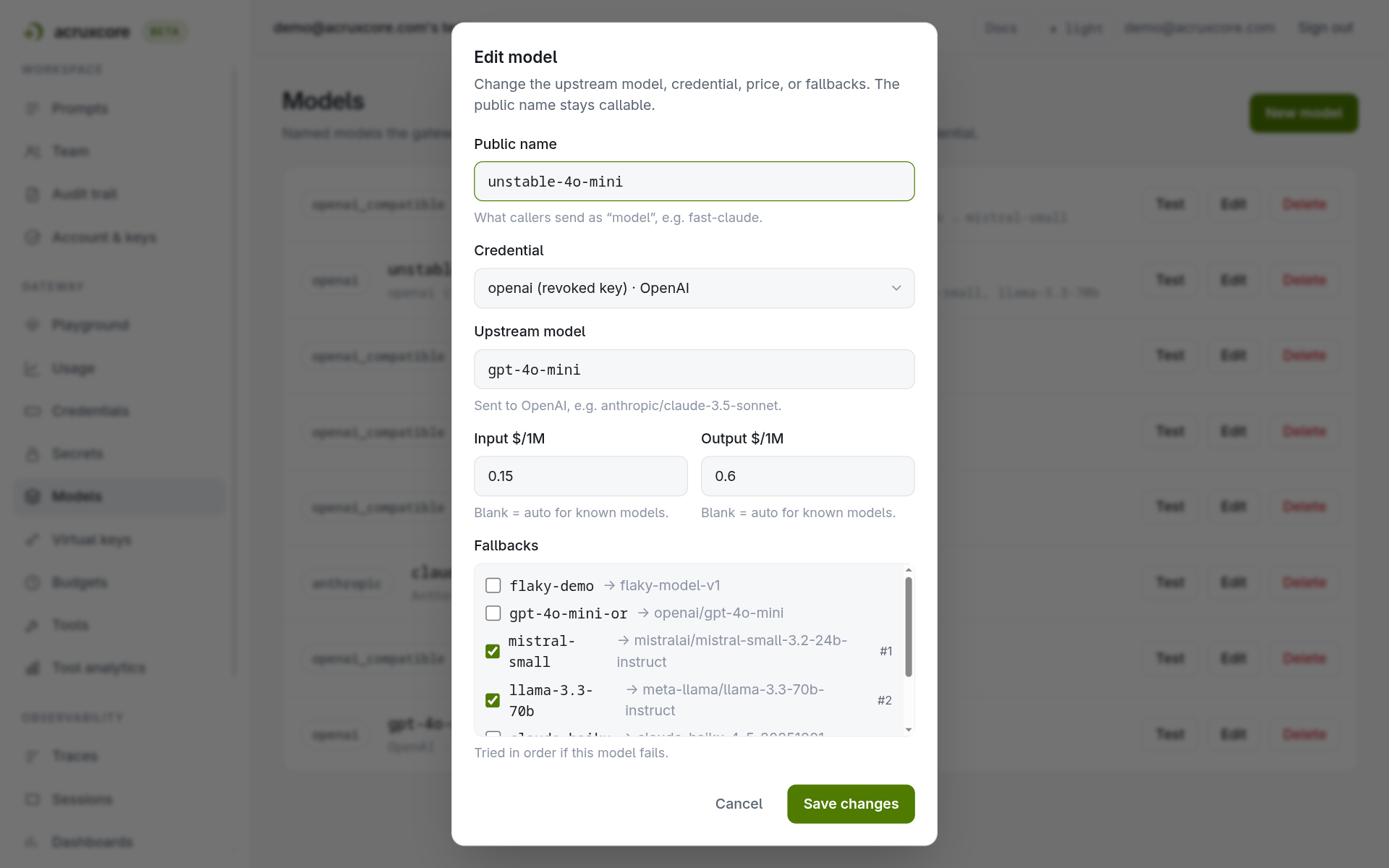
unstable-4o-mini is deliberately broken: its credential is a revoked OpenAI key, so
every call to it fails at the provider and falls back to mistral-small. The rest of
this guide uses both it and free-tier-model.
A chain is registry configuration, not something an application changes per request, so
there is no SDK method for it. To set one from a script instead of the dialog, send
fallbackModelIds to PATCH /gateway/models/:id — see Gateway Models in the
API Reference.
2. Set the retry count for a call
The retry count is the opposite: it belongs to the call, not to the model. Send it
in a gateway object alongside the normal OpenAI-shaped fields.
- curl
- Python (SDK)
- Node (SDK)
curl -X POST "$ACRUXCORE_BASE_URL/gateway/chat/completions" \
  -H "Authorization: Bearer $ACRUXCORE_API_KEY" \
  -H "Content-Type: application/json" \
  -d '{
    "model": "unstable-4o-mini",
    "messages": [{"role": "user", "content": "Say hello in five words."}],
    "gateway": {"maxRetries": 2}
  }'
{"id":"gen-1789326117-dHhmxpG4NKdNAaAf3359","model":"mistralai/mistral-small-3.2-24b-instruct","object":"chat.completion","created":1789326117,"choices":[{"index":0,"message":{"role":"assistant","content":"\"Hello, how are you today?\""},"finish_reason":"stop"}],"usage":{"prompt_tokens":9,"completion_tokens":9,"total_tokens":18}}
from acruxcore import AcruxCore

hub = AcruxCore()

result = await hub.gateway.chat(
    "unstable-4o-mini",
    [{"role": "user", "content": "Say hello in five words."}],
    gateway={"max_retries": 2},
)
print(result.model)
mistralai/mistral-small-3.2-24b-instruct
import AcruxCore from '@acruxcoreai/sdk';

const hub = new AcruxCore();

const result = await hub.gateway.chat({
  model: 'unstable-4o-mini',
  messages: [{ role: 'user', content: 'Say hello in five words.' }],
  gateway: { maxRetries: 2 },
});
console.log(result.model);
mistralai/mistral-small-3.2-24b-instruct
Each SDK spells the key the way its own language does — max_retries in Python,
maxRetries in Node — and both send maxRetries on the wire.
The request asked for unstable-4o-mini. The answer came back from
mistralai/mistral-small-3.2-24b-instruct, because the fallback served it. The
gateway object is stripped from the body before it reaches the provider, so the
outgoing request stays OpenAI-compatible.
maxRetries accepts 0 to 5 and nothing else. Above that the call is rejected before
it costs anything:
curl -X POST "$ACRUXCORE_BASE_URL/gateway/chat/completions" \
  -H "Authorization: Bearer $ACRUXCORE_API_KEY" \
  -H "Content-Type: application/json" \
  -d '{"model": "unstable-4o-mini", "messages": [{"role": "user", "content": "hi"}], "gateway": {"maxRetries": 9}}'
{"error":{"code":"VALIDATION_ERROR","message":"Number must be less than or equal to 5"}}
Both SDKs raise that same rejection rather than clamping the number, so a value out of range fails on the first call instead of quietly running with a different one.
Setting maxRetries to 0 turns same-model retries off entirely without touching
the fallback chain. Use 0 when a call is not safe to repeat.
3. Refuse to fall back for one call
The other key in the same object is fallback. It defaults to true, and false
means "this model or nothing": the call stays on the model you asked for, and its
failure comes back to you as an error instead of a different model's answer.
- curl
- Python (SDK)
- Node (SDK)
curl -X POST "$ACRUXCORE_BASE_URL/gateway/chat/completions" \
  -H "Authorization: Bearer $ACRUXCORE_API_KEY" \
  -H "Content-Type: application/json" \
  -d '{"model": "unstable-4o-mini", "messages": [{"role": "user", "content": "Say OK"}], "max_tokens": 5, "gateway": {"fallback": false}}'
{"error":{"code":"PROVIDER_ERROR","message":"Provider error (401): OpenAI request failed with status 401"}}
from acruxcore import AcruxCoreError

try:
    await hub.gateway.chat(
        "unstable-4o-mini",
        [{"role": "user", "content": "Say OK"}],
        max_tokens=5,
        gateway={"fallback": False},
    )
except AcruxCoreError as err:
    print(err.status_code, err.code)
    print(err)
502 API_ERROR
acruxcore API error 502 calling chat completions: Provider error (401): OpenAI request failed with status 401
import { acruxcoreError } from '@acruxcoreai/sdk';

try {
  await hub.gateway.chat({
    model: 'unstable-4o-mini',
    messages: [{ role: 'user', content: 'Say OK' }],
    maxTokens: 5,
    gateway: { fallback: false },
  });
} catch (err) {
  if (err instanceof acruxcoreError) {
    console.log(err.statusCode, err.code);
    console.log(err.message);
  }
}
502 API_ERROR
acruxcore API error 502 calling chat completions: Provider error (401): OpenAI request failed with status 401
The status is 502, and the message carries the revoked credential's own 401. From
either SDK the call raises instead of returning, so a caller that ignores the return
value still cannot miss it. The same call without the gateway object is answered by
mistral-small with a 200, and nothing in that response says a different model wrote
it.
Send fallback: false when a different model would be worse than an error. Three
cases where it is: an evaluation run that has to name one model, a cost ceiling a
larger fallback would break, and a prompt tuned to one model's output format.
Retries are unaffected, because a retry is the same model.
4. Read which one happened in the trace
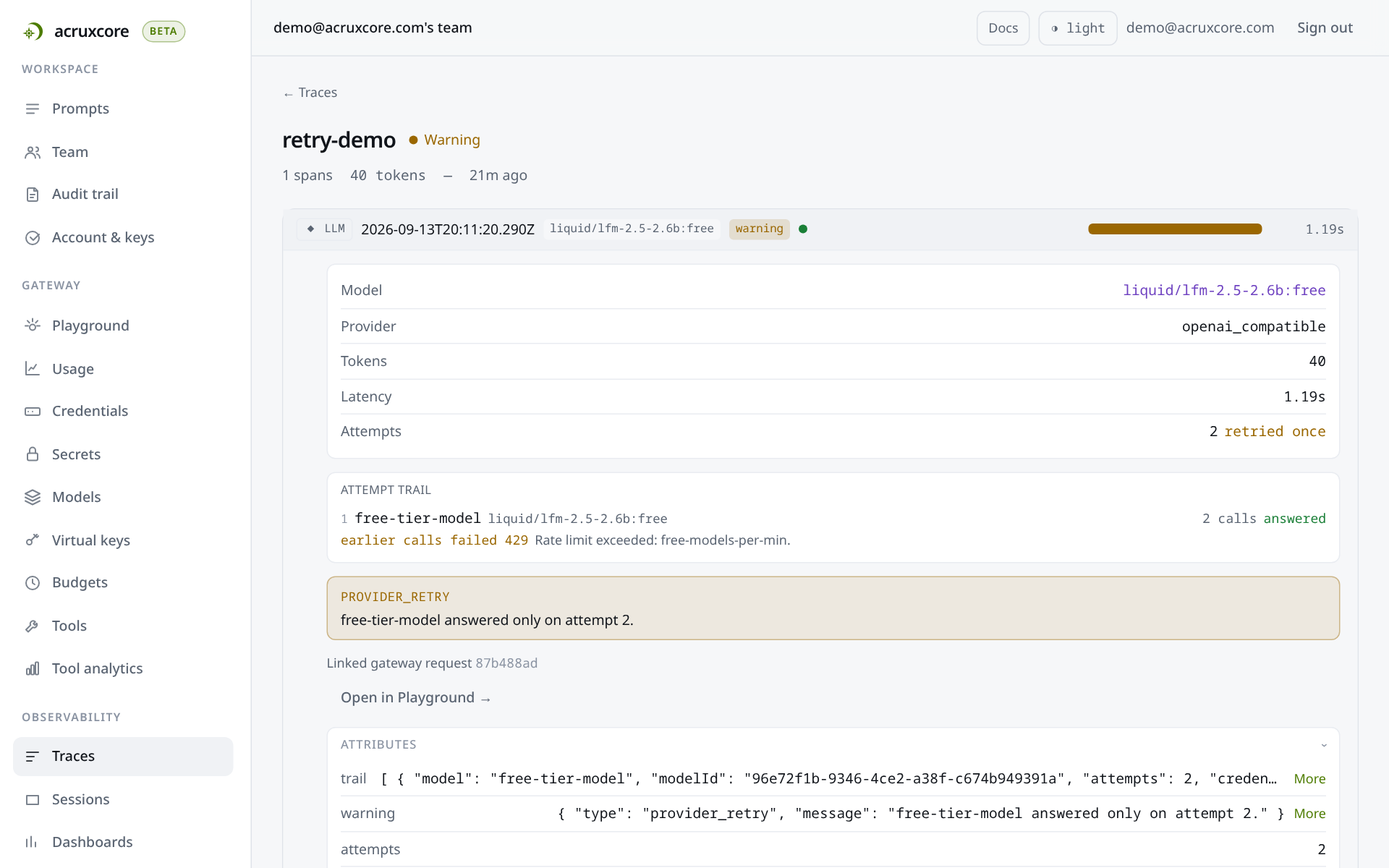
Open the trace for a call and expand its llm span. A call that took more than one
attempt gets an Attempts row saying which of the two happened. Below it, an
Attempt trail lists every model the gateway tried, in order.
Here is a call that was retried. free-tier-model hit its provider's per-minute
limit, the gateway called it again, and the second call answered:
And here is a call that fell back. unstable-4o-mini answered 401 on its revoked
key, so mistral-small served the request instead:
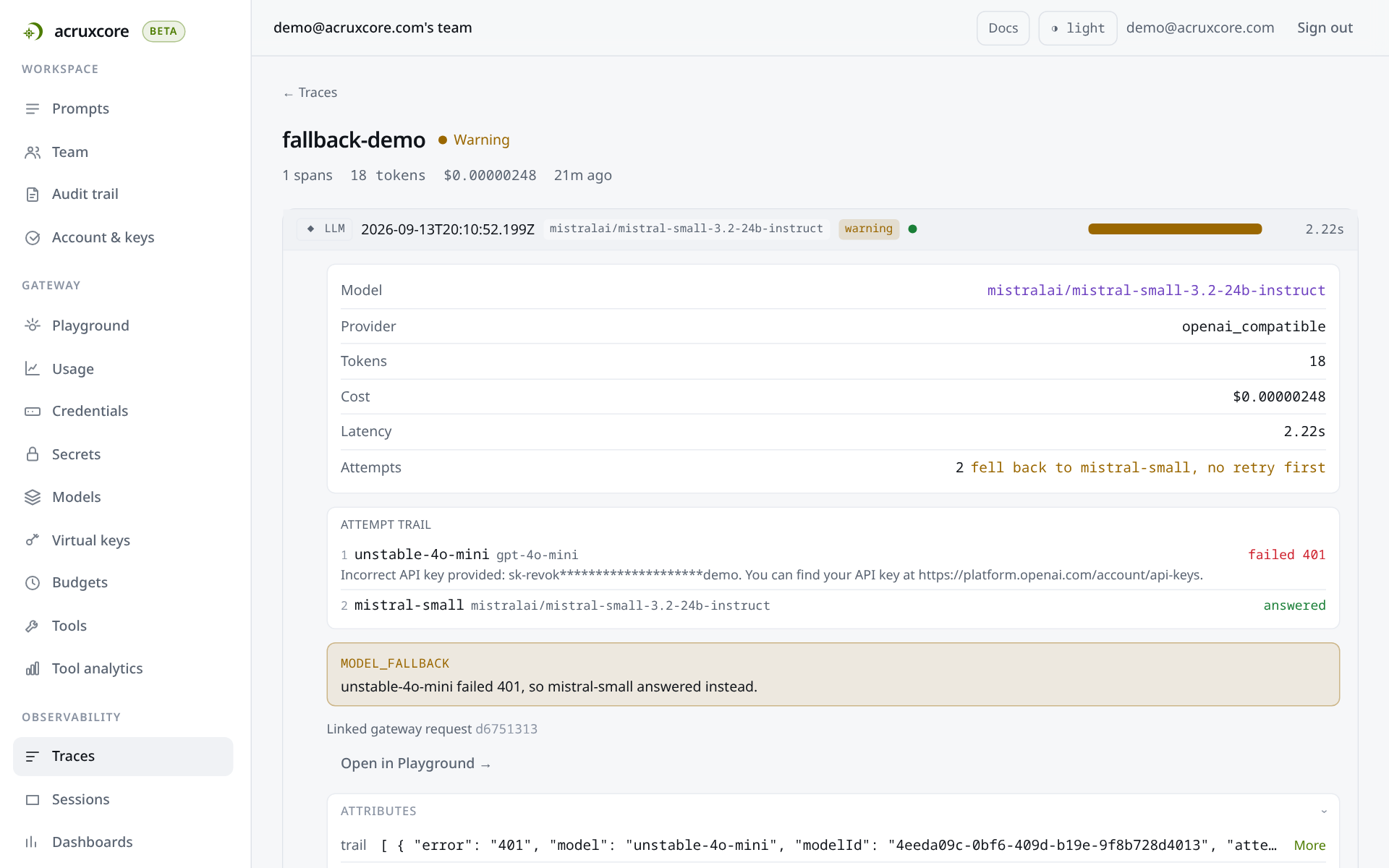
Each row of the trail holds four things: the registered name of the model, the upstream name its provider knows, how many times that one model was called, and how its turn ended. One row means one model was used. Two rows mean the call fell back.
The call count is per model, not for the whole chain. That matters for the third case, where a model is retried several times and then falls back. Its first row shows several calls and its second row shows one. A single total for the whole chain cannot tell that apart from a fallback that never retried.
The line under a row is the provider's own message, not ours. 401 tells you that an
attempt failed. "Incorrect API key provided" tells you what to fix. A model that answered
only after a retry keeps that message too, marked earlier calls failed, so a rescued
call still records what was going wrong.
A call that succeeded first time has no Attempts row and no trail, because there is nothing to account for.
5. Find a model that is failing behind its fallback
A fallback leaves no sign that it ran. The caller gets an answer, the request counts as a success, and the trace is green. So a primary model that fails on every request stays invisible for as long as its fallback keeps answering. The model you are billed for changes and the model that wrote the answer changes, and the list says neither.
That is why a run which only succeeded because it was retried or fell back is flagged
amber in the trace list instead of green. It is still ok. It is not an error and it does
not count as one. It is marked:
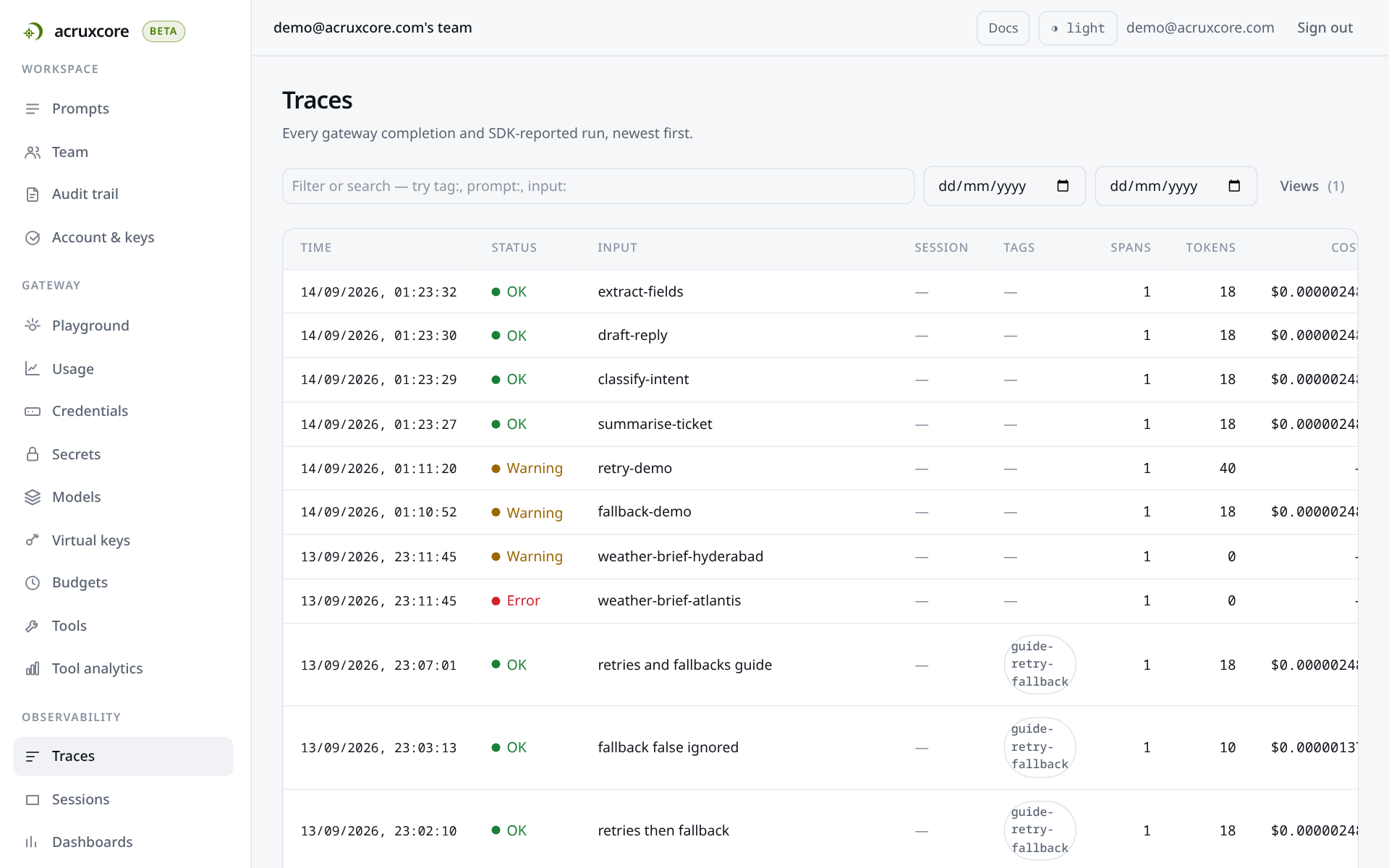
Type warning:yes in the trace list's filter bar to see only those runs. Then look at
which model sits in the first row of each trail. A model that appears there every time is
one to fix or retire, because every call to it costs latency and returns no answer.
6. What is never retried, and what is never fallen back to
Not every failure gets the same treatment, and the differences are deliberate.
| What the provider returned | Retried on the same model? | Falls back to the next model? |
|---|---|---|
A network error, a timeout, a 5xx, or a 429 | Yes, up to maxRetries | Yes, once the retries are used up |
401 or 403, a bad or revoked credential | No | Yes |
400, a request the provider rejected | No | No — the error is returned to you immediately |
A bad credential is not going to fix itself between two attempts a fraction of a second apart, so retrying it only adds latency. A different model on a different credential might still work, so the fallback still runs.
A 400 stops everything because it almost always means the request itself is wrong:
a typo in the upstream model name, or a schema the provider will not accept. Every
model in the chain would reject it the same way, so fanning out would turn one clear
error into several slow ones.
Between retries the gateway backs off: roughly 200ms, then 400ms, then 800ms, each with a little jitter and capped at 2 seconds. A provider that is already struggling is not hit harder by its own clients.
The same keys on the SDK's other calls
gateway.stream(), gateway.runToolLoop() and gateway.runPromptWithTools() take the
same gateway argument as gateway.chat() above, and the tool loop applies it to every
round. The argument is sent only on a gateway call. A BYO-provider call never reaches an
AcruxCore gateway, so there is nothing there to control.
One difference on a streaming call: gateway.maxRetries is ignored, because a stream
commits to a model as soon as its first chunk arrives and there is nothing left to retry.
gateway.fallback still applies, because the model is chosen before the first chunk.
The client constructor takes a retry count of its own: AcruxCore(max_retries=2) in
Python, new AcruxCore({ maxRetries: 2 }) in Node. That one retries this SDK's own HTTP
request to AcruxCore. It changes nothing about how many times OpenAI or Anthropic is
called. The per-call gateway argument is the one that reaches the provider. Setting the
constructor's when you meant the per-call one produces no error and no effect.
What's next
- Send your first call through the gateway — see Route your app's LLM calls through the gateway.
- Cap what a key can spend even when every deployment succeeds — see Set spend limits with gateway budgets and rate limits.
- Full field reference: Gateway and Gateway Models in the API Reference.