Use conditional logic in prompt templates
What you'll build: a vip-support-triage prompt whose system message changes
shape depending on the caller's input — one paragraph for VIP customers, a
loop that lists out an array of open tickets — using the same {% if %} /
{% for %} syntax you'd write in Jinja2 or Django templates.
Every prompt message in AcruxCore is a template, not a plain string.
{{ variable }} substitutes a value, which covers most prompts. But a template
can also carry logic: skip a paragraph when something doesn't apply, or repeat
a block once per item in a list. AcruxCore renders templates with
nunjucks, a JavaScript templating
engine that implements the same tag syntax as Python's Jinja2 — so {% if %},
{% else %}, {% for %}, and filters like {{ x | default('...') }} all work
exactly as they do in either engine.
1. Create the prompt
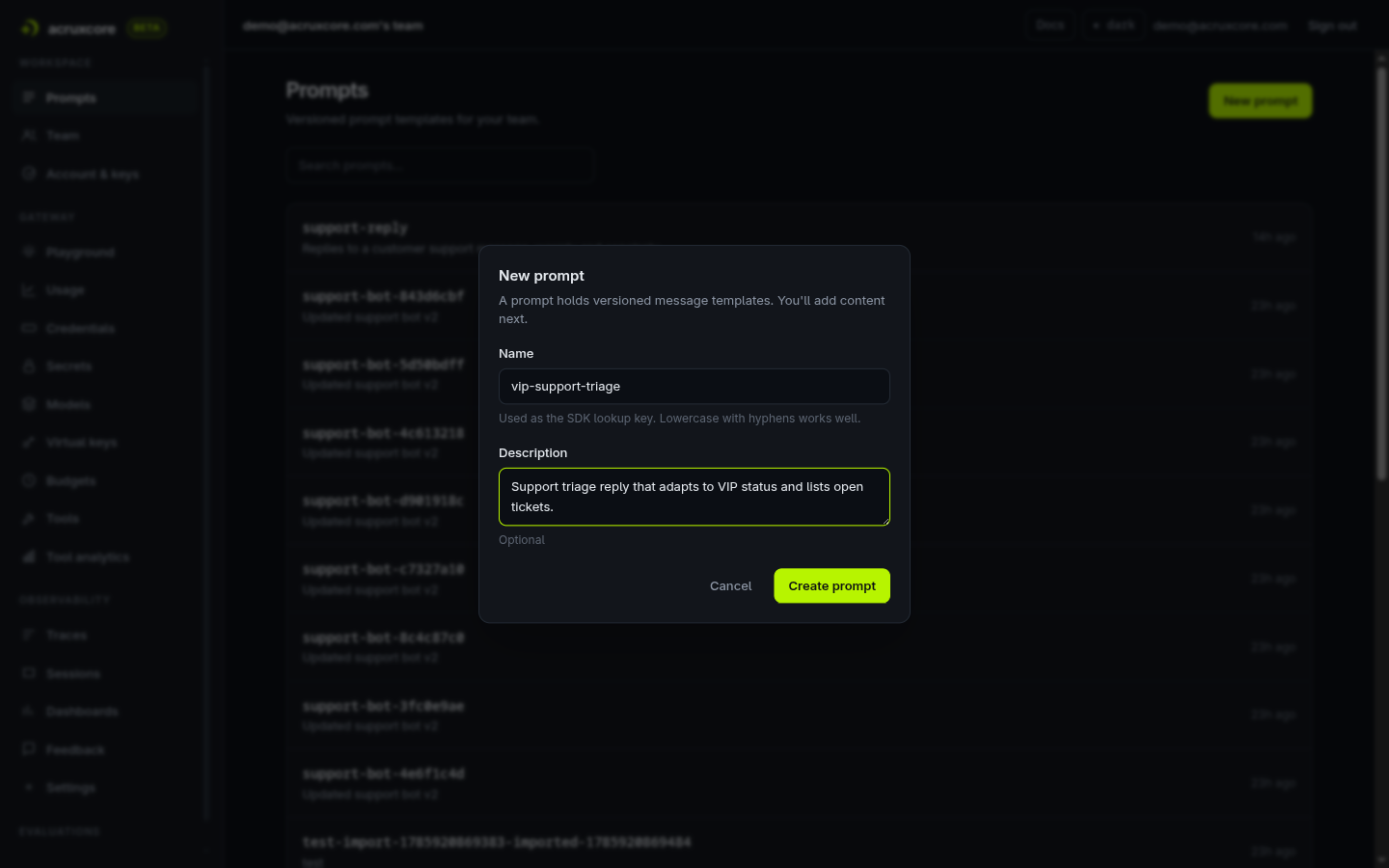
On Prompts, click New prompt and name it vip-support-triage.
2. Write the template with {% if %} and {% for %}
In the Editor, the system message's placeholder text already hints at this:
"Use {{ variables }} and {% logic %}." Write a system message that
branches on a is_vip flag and loops over a tickets list:
You are a support triage agent for {{ company }}.
{% if is_vip %}This customer is VIP — prioritize them and skip standard hold times.{% else %}Standard support flow applies.{% endif %}
{% if tickets and tickets.length %}Open tickets:
{% for ticket in tickets %}- #{{ ticket.id }}: {{ ticket.title }}
{% endfor %}{% else %}No open tickets.{% endif %}
The user message is just {{ customer_message }}. Set the Default model
to whichever chat model you have configured, then Commit new version.
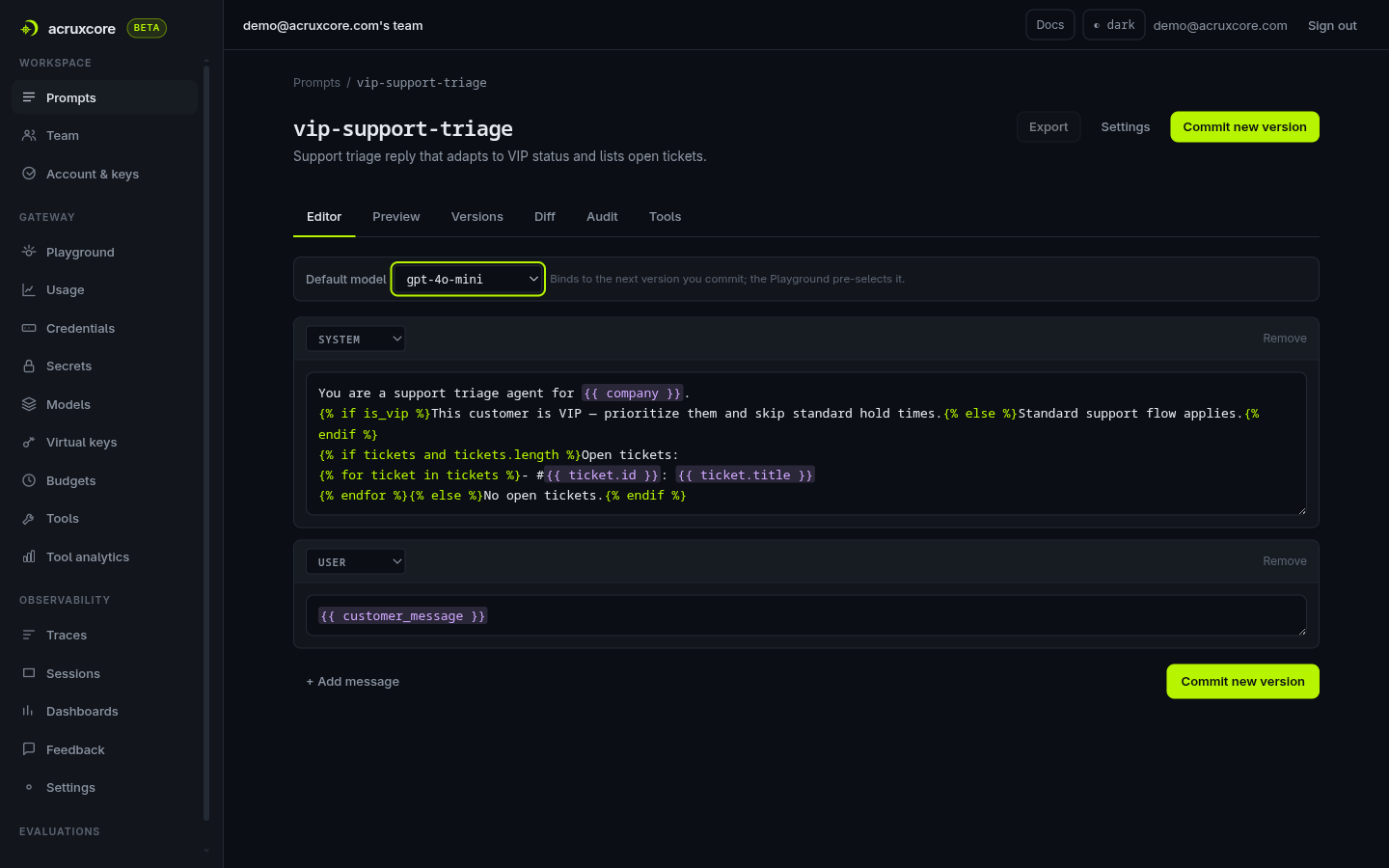
The editor highlights {{ }} and {% %} the same way — both are template
syntax, not plain text, and both get replaced or evaluated at render time.
3. Preview the rendered output
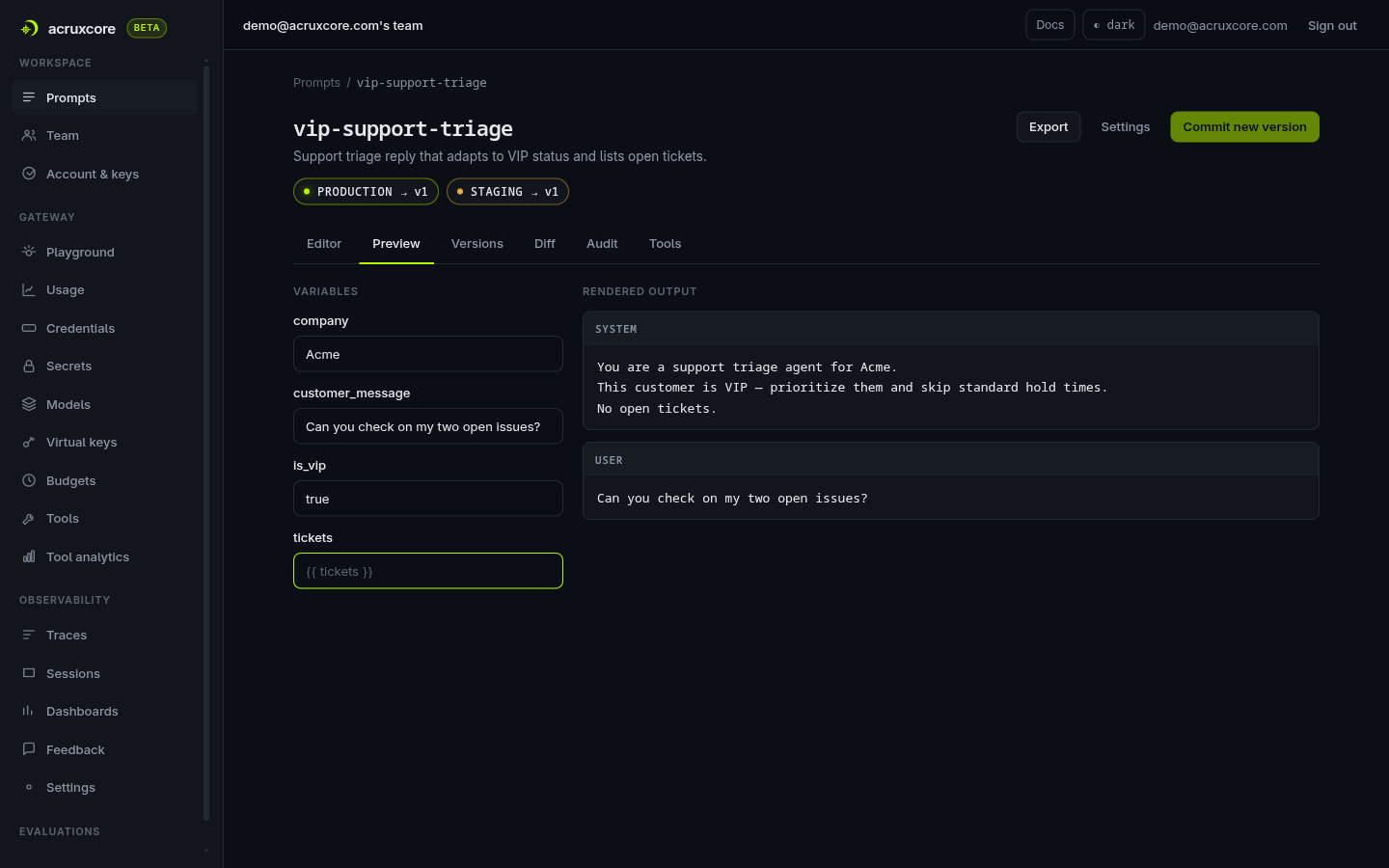
Switch to Preview. It lists every variable your template reads from the
outside — company, customer_message, is_vip, tickets — and leaves out
ticket, since that name is bound by the {% for %} loop itself, not
something your app provides. Fill in a company, a message, and a truthy
is_vip, and the VIP branch renders live:
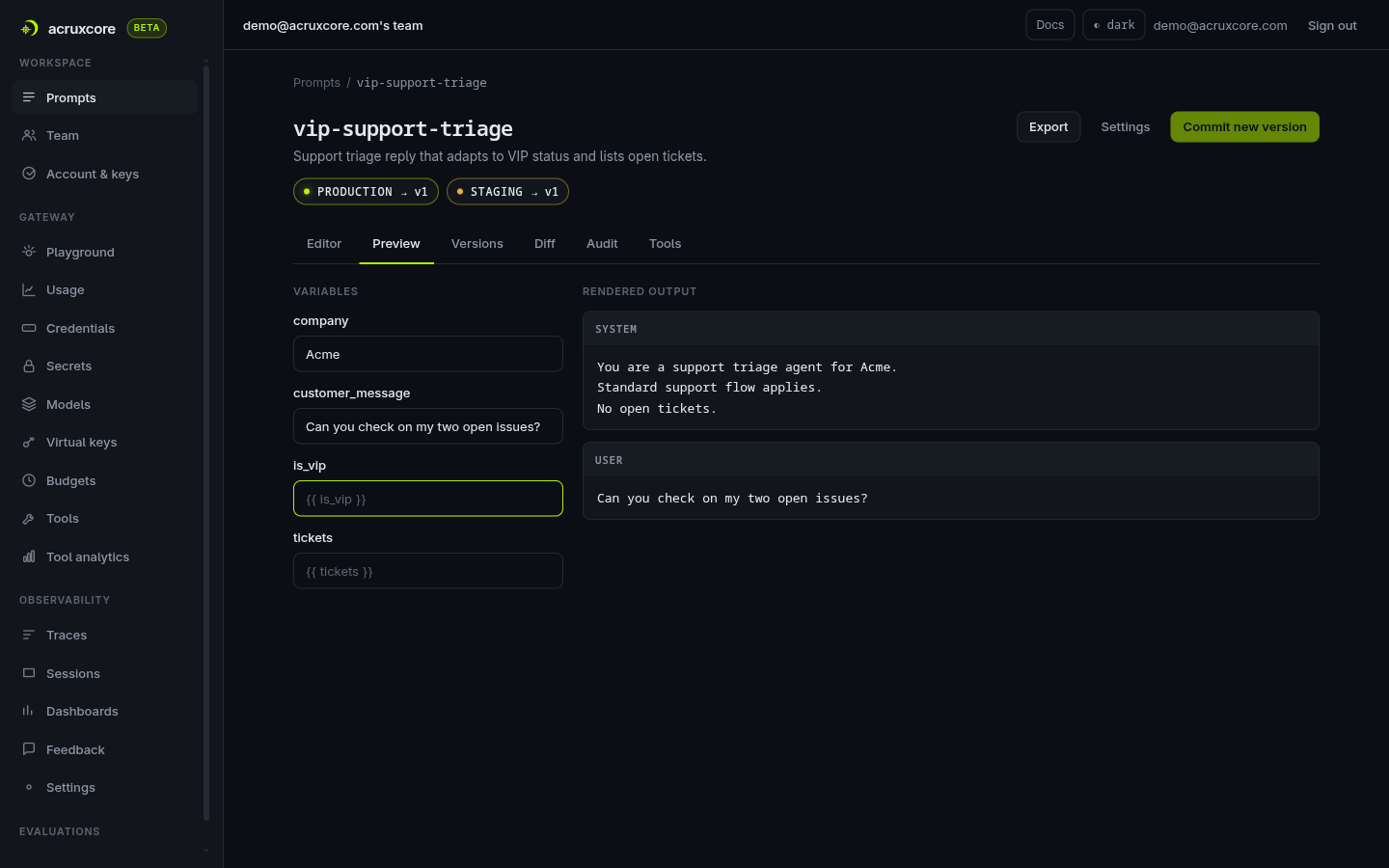
Clear is_vip and the same template falls through to the {% else %} branch
instead — no version change needed, just a different input:
The Preview tab only accepts plain text per variable, so it can't exercise the
{% for %} loop with a real list — tickets needs an actual array, not a
string. Test the loop against the real render endpoint instead, covered next.
Doing this over the API
Your app renders the same template server-side before sending it to a model —
this is what the SDK's render call and the gateway's promptVersionId option
both do under the hood. Passing a real array for tickets drives the
{% for %} loop correctly:
- curl
- Node (SDK)
- Python (SDK)
- Python (requests)
curl -X POST "$ACRUXCORE_BASE_URL/prompts/vip-support-triage/production/render" \
  -H "Authorization: Bearer $ACRUXCORE_API_KEY" \
  -H "Content-Type: application/json" \
  -d '{
    "variables": {
      "company": "Acme",
      "customer_message": "Can you check on my two open issues?",
      "is_vip": true,
      "tickets": [{"id": 101, "title": "Order delayed"}, {"id": 102, "title": "Refund request"}],
      "ticket": null
    }
  }'
{
  "messages": [
    {
      "role": "system",
      "content": "You are a support triage agent for Acme.\nThis customer is VIP — prioritize them and skip standard hold times.\nOpen tickets:\n- #101: Order delayed\n- #102: Refund request\n"
    },
    {"role": "user", "content": "Can you check on my two open issues?"}
  ],
  "tools": [],
  "model": "gpt-4o-mini",
  "versionId": "e0397984-a9ff-4665-935d-947b41c1f7ff",
  "versionNumber": 1
}
import AcruxCore from '@acruxcoreai/sdk';

const hub = new AcruxCore();

const { messages } = await hub.prompts.render('vip-support-triage', 'production', {
  company: 'Acme',
  customer_message: 'Can you check on my two open issues?',
  is_vip: true,
  tickets: [{ id: 101, title: 'Order delayed' }, { id: 102, title: 'Refund request' }],
  ticket: null,
});
from acruxcore import AcruxCore

hub = AcruxCore()

render = await hub.prompts.render("vip-support-triage", "production", {
    "company": "Acme",
    "customer_message": "Can you check on my two open issues?",
    "is_vip": True,
    "tickets": [{"id": 101, "title": "Order delayed"}, {"id": 102, "title": "Refund request"}],
    "ticket": None,
})
import os, requests

base, key = os.environ["ACRUXCORE_BASE_URL"], os.environ["ACRUXCORE_API_KEY"]
h = {"Authorization": f"Bearer {key}"}

resp = requests.post(f"{base}/prompts/vip-support-triage/production/render", headers=h, json={
    "variables": {
        "company": "Acme",
        "customer_message": "Can you check on my two open issues?",
        "is_vip": True,
        "tickets": [{"id": 101, "title": "Order delayed"}, {"id": 102, "title": "Refund request"}],
        "ticket": None,
    },
})
messages = resp.json()["messages"]
One thing worth knowing: render currently requires a value for every name the
template references, including a {% for %} loop's own loop variable
(ticket above) — its value is never actually read, so any placeholder like
null satisfies it. Leaving it out entirely returns a 400 naming it as
missing.
What's next
- Version a prompt and ship it to production covers committing, promoting, and rendering a prompt end to end — this guide only focused on the template syntax itself.
- Route the rendered prompt through the gateway to send the rendered messages to a model.
- API details: see Prompts and Versions in the API Reference.